A roofing website needs a tap-to-call button and a Free Inspection button on the first phone screen, your Google reviews on the homepage, a storm and hail damage page that explains insurance claims, a correctly labeled license or registration number, and a layout that works on a phone. In our October 2026 check of 15 top-ranked roofer websites, 14 had tap-to-call on the first screen, but only 10 showed reviews, 9 had a storm or insurance page, 4 showed a license number, 3 took online bookings and none showed a price. Hail-damage searches start rising in March and peak in May, so a storm page should be live by February or early March.
What We Found on 15 Top Roofer Websites
We searched roofer + city on Google Maps in Phoenix, Dallas, Atlanta, Columbus and Philadelphia, took the top three organic results in each city and opened the website behind each listing on a phone-sized screen. All 15 were independent local roofers, with no franchises in the sample. The full method is at the end of this page.
What 15 top-ranked roofer websites show
Number of sites out of 15 · homepage on a phone screen · checked October 26, 2026
More from the same 15 sites:
- 12 run on WordPress, and one each on Wix, HubSpot CMS and custom code.
- 5 show a past year in the footer (2020, 2024 or 2025), a small sign nobody has touched the site in a while. All 15 use HTTPS.
- Their Google profiles are strong: an average rating of 4.87, with a median of about 520 reviews. Yet 5 of these 15 don't show a single review on their homepage.
Roofers vs Plumbers: A Weaker Top
We ran the exact same check on 15 top-ranked plumber websites in the same five cities on the same day. Side by side, the roofers' sites are noticeably weaker on everything except the basic call and quote buttons:
Top-ranked plumbers vs roofers: share of 15 sites with each element
Same five cities, same method · October 26, 2026
One likely reason: plumbing is an emergency business with heavy competition for every call, so the top plumbers invest in booking software, review widgets and constant updates. Roofing jobs are bigger and rarer, and many roofers still treat the website as a brochure. For a roofer who gets the basics right, that's good news: the bar to clear at the top of Google Maps is lower than in plumbing.
The First Screen: Three Problems We Saw
Most of the 15 had a call button and a quote button visible straight away. The exceptions are worth a look, because each one is easy to make and costs calls:
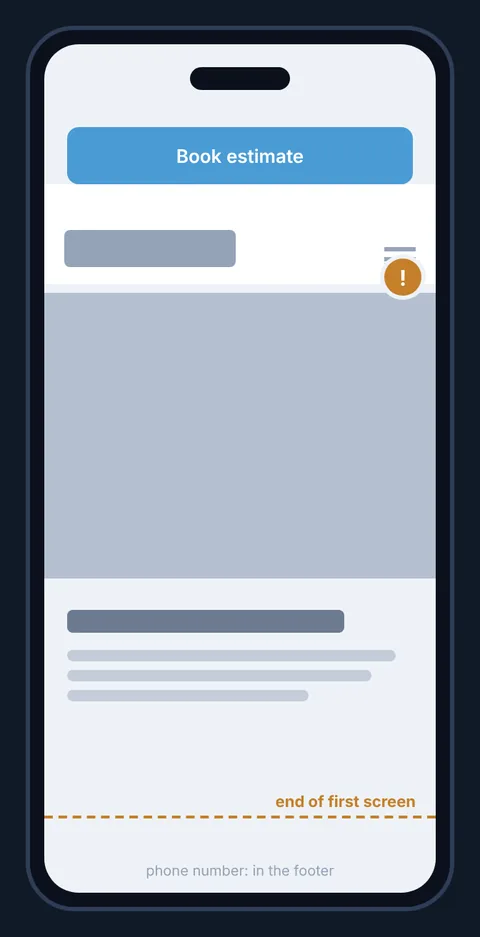
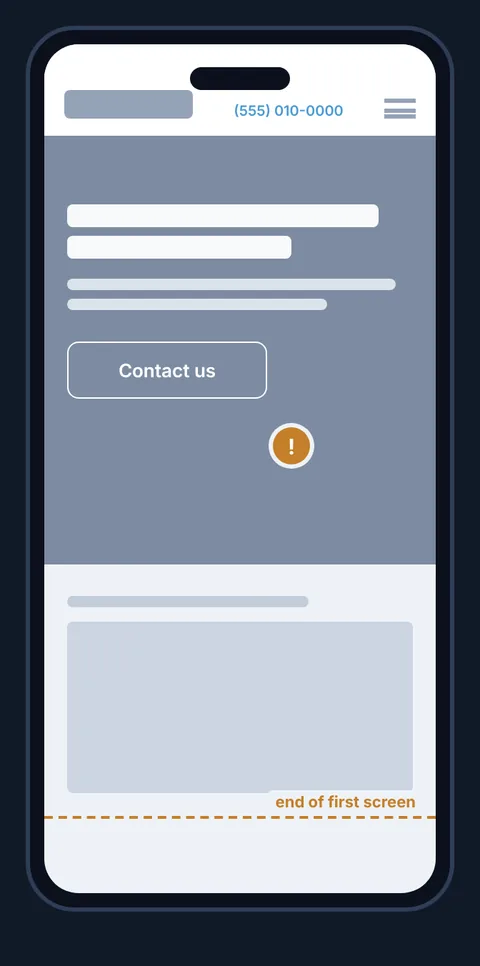
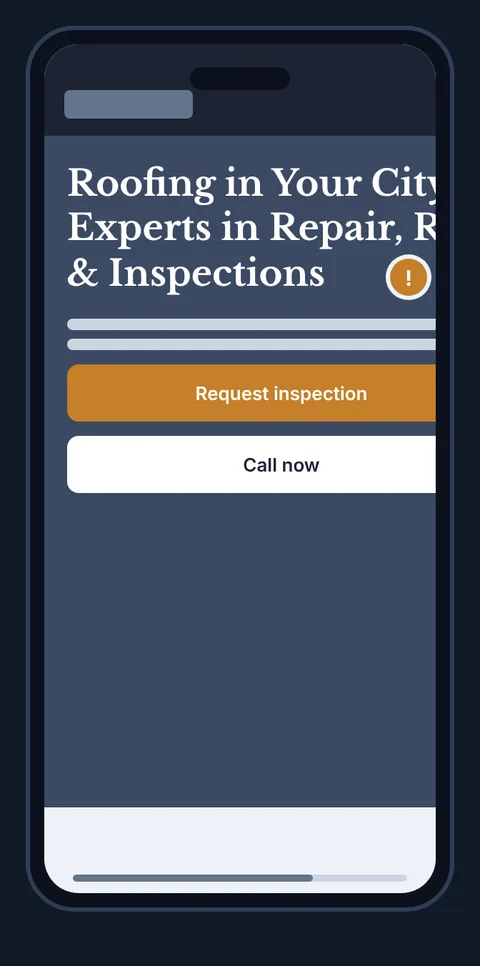
That last problem belongs to a wider pattern: 5 of the 15 sites had visible layout problems on a phone, such as image slots that never loaded, dark text on a dark background, or blocks out of place. None of these show up when the owner checks the site on a desktop, so open your own site on a phone today.
What a strong roofing first screen looks like
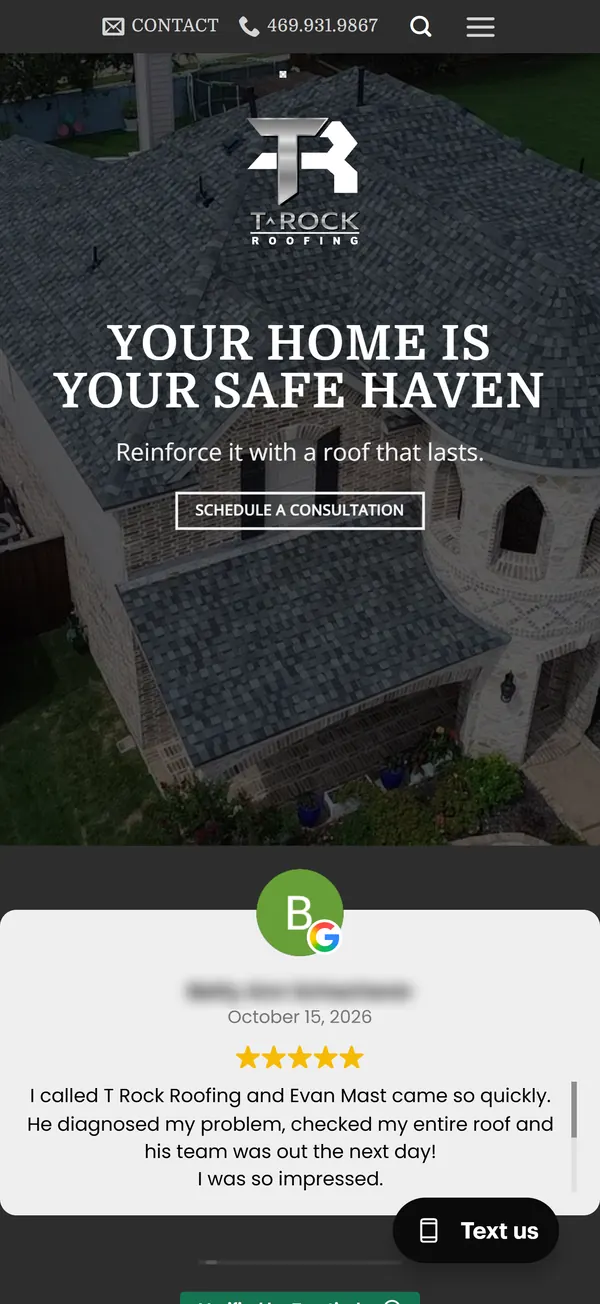
Here is the first screen we'd build for a roofer, combining the best of what the top sites do with what most of them skip:
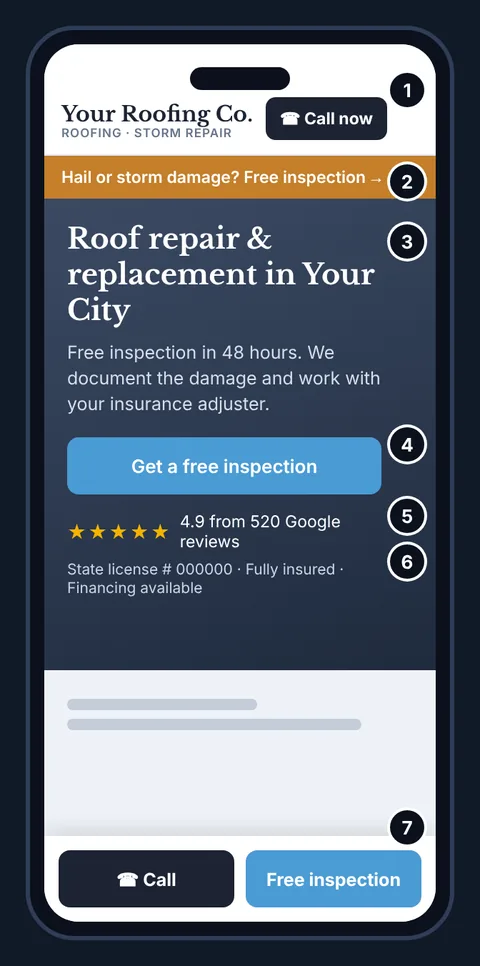
- Call button in the header, styled as a button. 14 of 15 had tap-to-call, but on some it was plain text that's easy to miss.
- A storm banner linking to the storm and insurance page. Switch it on in hail season and turn it down in winter.
- Service + city in the headline, so both Google and the homeowner know they're in the right place.
- One clear offer: “Free inspection” rather than “Contact us”.
- Rating with the review count. Only 10 of 15 showed reviews on the homepage.
- License or registration number, labeled exactly as your state issues it, plus insurance and financing.
- A sticky bar with Call and Free inspection that stays on screen while the visitor scrolls.
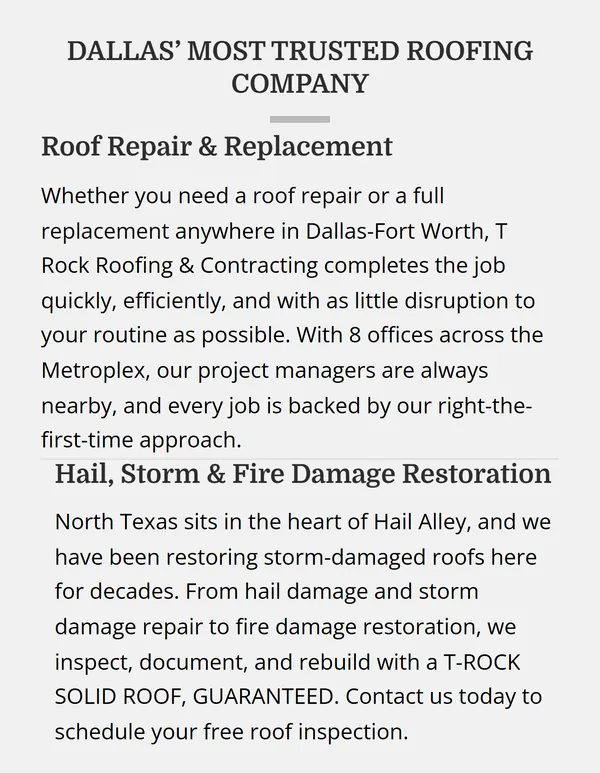
And a real example from the study that gets most of this right:
Storm Pages and When to Launch Them
For many roofers, storm and hail damage is the most profitable work of the year, and insurance claims are what homeowners are most unsure about. Yet only 9 of 15 top-ranked roofers had a page or menu item about storm damage or insurance claims. By city:
| City | Storm page | State hail index* |
|---|---|---|
| Phoenix, AZ | 3 of 3 | 11 |
| Atlanta, GA | 3 of 3 | 17 |
| Dallas, TX | 2 of 3 | 52 |
| Columbus, OH | 1 of 3 | 18 |
| Philadelphia, PA | 0 of 3 | 9 |
On two of the sites without one, “storm damage” appeared as a single word in a list of services, with no page behind it. That is not something a homeowner holding an adjuster's letter can use.
Hail-damage searches peak in May
We pulled five years of US Google Trends data (October 2021 – October 2026) for hail damage, roof repair and roof leak. For each month we compared interest with that year's average, then averaged across 2022–2025:
US searches for “hail damage” by month
Monthly interest vs that year's average (1.0×), averaged over 2022–2025 · Google Trends, United States
- Hail damage is strongly seasonal: interest climbs in March, peaks in May at about 1.8× the yearly average and stays above average through August. December–February run at about half the average.
- Roof repair barely moves: about 0.85× in late winter and 1.2× in July–August.
- Roof leak is flat all year (0.9–1.1×), with small bumps in winter and late summer.
Publish or refresh your storm page in February or early March. A new page needs time to be crawled, indexed and linked before demand rises in March and peaks in May. A page launched after the first big storm is already late. Repair and leak pages can go up any time, since that demand is steady.
Where hail damage is searched most
Interest is concentrated in the Plains and Mountain states. Top 10 by Google Trends' state index (100 = the highest share of searches):
“Hail damage” search interest by state, top 10
Google Trends index, 0–100 · United States, past 5 years
If you work in one of these states, a storm page is close to mandatory, and it's worth separate pages for hail damage, wind damage and insurance claims. In low-hail states, one page covering storm damage and insurance claims is enough, but it should still exist. Storms happen everywhere, and a homeowner with a claim wants to see you've handled one before.
What to put on a storm damage page
- A clear offer: free inspection, how fast you come out, and that you document the damage with photos.
- How the insurance process works, step by step: inspection, claim, adjuster meeting, approval, repair. Say plainly what you do and what the homeowner does.
- Your license or registration and insurance, near the top. Storm season brings out-of-town crews, and a checkable number separates you from them.
- Photos of real hail and wind damage from your area, and the finished repairs.
- A short FAQ in plain English: Will my premium go up? What if the adjuster denies it? How long do I have to file?
Check your state's rules before promising anything about claims. Several states restrict what contractors can say or do on a homeowner's insurance claim.
A note on the data: Google Trends shows relative interest, not search counts. US interest in “roof repair” jumped about threefold from early 2025, which looks like a change in how Google samples the data rather than a real surge in demand, so we compare each month with its own year's average instead of comparing years.
License Numbers: What Your State Expects
Only 4 of 15 roofers showed a license or registration number on the homepage, and 9 more wrote “licensed” without one. Part of the reason is that in many states there is no state roofing license to show. Here is the picture in the five states from our study:
| State | State license for roofers? | What to show on your website |
|---|---|---|
| Arizona | Yes, through the Registrar of Contractors (ROC) | The ROC number. Ads must carry it. Some ads can skip it only if the website shows the name and ROC number prominently on the home page, not in the footer.Source: azroc.gov |
| Texas | No. A 2025 bill to create one (HB 3344) did not pass | Any voluntary credential you hold, such as the RCAT license from the Roofing Contractors Association of Texas, labeled as what it is, plus insurance and any city registration.Sources: Texas Legislature bill analysis, LegiScan |
| Georgia | No separate roofing license. Roofing is a specialty that doesn't need the residential or general contractor license | Business license, insurance, manufacturer certifications. A state contractor license if you also do general work.Source: Georgia Secretary of State |
| Ohio | No. The state board licenses plumbing, HVAC, electrical and similar trades, not roofing | City registration where required, insurance and certifications.Source: Ohio House |
| Pennsylvania | No license, but home improvement contractors must register with the Attorney General | The PA registration number, which the law requires “in any advertisements”. In Philadelphia, contractors who hold a city contractor license must show that number on ads too.Sources: PA Attorney General, phila.gov |
The pattern in our data matches: 2 of the 3 Phoenix roofers, where a state license exists, showed a license number. Only 2 of the other 12 did.
Whatever you hold, show it the way T Rock Roofing does: say exactly what it is and give the number.
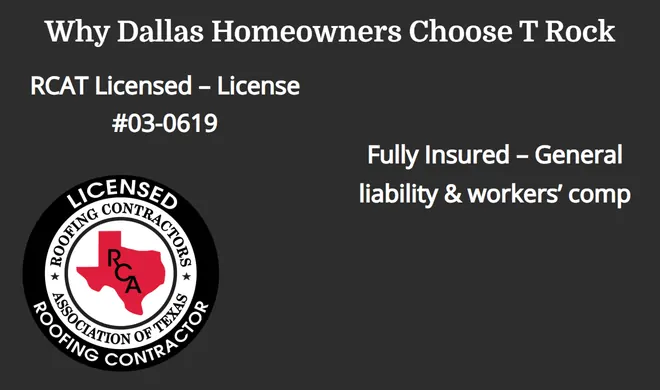
Don't call a registration a “license”, and don't write “state licensed” in a state that doesn't license roofers. Homeowners and competitors can check, and in some states the wording itself is regulated.
What a Roofing Website Needs
Based on what the top 15 do, what they skip and when homeowners search, here is the checklist we build every roofing website against:
A call button that's an actual button
Visible on the first screen and pinned while scrolling. 14 of 15 had tap-to-call, but on some it was small plain text.
“Free inspection”, not “Contact us”
Name the offer. 13 of 15 had an Inspection, Estimate or Quote button on the first screen.
A storm and insurance page, live by March
Only 9 of 15 had one, and none of the three in Philadelphia. Hail-damage searches peak in May.
Reviews on the homepage, with the count
The median top roofer has about 520 Google reviews, yet 5 of 15 didn't show any on their homepage.
License or registration, labeled correctly
Show the number your state issues (ROC, PA registration, city license) or the credential you hold. Only 4 of 15 showed one.
A number to anchor on
None of 15 showed a price. A typical repair range, a price per square or a financing example (“from $X/month”) sets you apart.
Photos of real roofs you've done
Before-and-after shots from your own jobs and your own area say more than any stock photo of a smiling roofer.
Test it on a real phone
5 of 15 had visible layout problems on mobile, and 5 showed an old year in the footer. Both take minutes to find and fix.
How We Build Roofing Websites
We build hand-coded roofing websites around the first screen shown above: call and inspection buttons that follow the thumb, reviews and your license line near the top, a storm and insurance section you can switch on before hail season, and a layout we test on real phones before launch.
Copy written for you, your real Google reviews, tap-to-call and an inspection form on every screen, a storm and insurance section, your license or registration line. Domain, hosting and SSL included. Monthly plan: $0 to launch, 12-month minimum, then the site is yours.
Everything above, plus separate pages for repair, replacement and storm damage & insurance claims, service-area pages for up to 3 towns, a project gallery, Google Business Profile setup and local SEO.
Every project starts with a free concept of your homepage. If you'd like your storm page live before the spring climb, now is a good time to start. More about our contractor website design work is on the homepage.
FAQ
A tap-to-call button and a Free Inspection or Estimate button on the first phone screen, Google reviews with the rating and count, a storm and hail damage page that explains insurance claims, your license or registration number, financing if you offer it, and photos of real jobs. In our October 2026 check of 15 top-ranked roofer websites, 14 had tap-to-call on the first screen, but only 10 showed reviews on the homepage, 9 had a storm or insurance page and 4 showed a license number.
In February or early March. Five years of Google Trends data show US searches for hail damage start climbing in March, peak in May at about 1.8 times the yearly average, and stay high through July. A page published before the climb has time to be crawled and indexed before demand arrives. See the chart.
It depends on the state. Arizona licenses roofers through the Registrar of Contractors, and ads must carry the ROC number. Texas, Georgia and Ohio have no state license for residential roofing, although cities may require registration or permits. Pennsylvania requires home improvement contractors to register with the Attorney General and show the PA registration number in ads, and Philadelphia requires its contractor license number on advertising. Show exactly what you hold and label it correctly. See the state table.
None of the 15 top-ranked roofer websites we checked showed any price. Roofs vary too much for a price list, but a free inspection, a typical price range for a repair or a replacement per square, or a financing example such as a monthly payment gives visitors a number to anchor on and sets you apart.
DIY builders run about $17 to $39 a month, agencies often bundle the site into retainers of several thousand dollars a month, and fixed-price studios sit in between. Mount Peak builds roofing websites for $139 a month with $0 to launch or $999 one-time, and a multi-page site with a separate storm damage page for $1,799, with a free homepage concept before you pay. Full cost breakdown.
How We Did This Study
- Date: all 15 sites were checked on October 26, 2026.
- Sample: Google Maps searches for “roofer Phoenix AZ”, “roofer Dallas TX”, “roofer Atlanta GA”, “roofer Columbus OH” and “roofer Philadelphia PA” in an incognito window with the interface in English. We took the top three organic results in each city and skipped sponsored listings, Google Local Services ads and directories (Angi, Yelp, HomeAdvisor, Thumbtack). No franchises appeared in the sample.
- What we opened: the page behind each listing's Website button, plus the main menu to look for a storm, hail or insurance-claim page.
- Phone view: Chrome device emulation at iPhone 16 Pro Max size (440 × 956). Disputed layout cases were re-checked on a real phone. “First screen” means what is visible before any scrolling.
- Definitions: tap-to-call means a phone number or button that opens the dialer; a quote button means Inspection, Estimate, Quote, Book or Schedule (“Contact us” alone doesn't count); a license number means digits, not just the word “licensed”; a storm page means a page or menu item about storm or hail damage or insurance claims (a single word in a list of services doesn't count); online booking means picking a date and time, not just sending a form. Financing and layout problems come from notes taken during the check, so treat them as minimums.
- Search data: Google Trends, United States, all categories, web search, October 27, 2021 – October 27, 2026, for “roof repair”, “hail damage” and “roof leak”; state interest for “hail damage” from the same period.
- Limits: 15 sites is a snapshot, not a census. Google Maps rankings shift with location and time, and websites change. We didn't submit forms or measure page speed. We name businesses only where we show something they do well.
If you own one of these websites and something here is out of date, email hello@mountpeakweb.com and we'll correct it. The same check for plumbers is in our plumbing website design study.
Get Your Roofing Website Ready Before Hail Season
Tell us about your company and we'll send a free concept of your new homepage in 2–4 business days, with a storm section ready to switch on, plus an honest look at what your current site is missing on a phone. No commitment.